

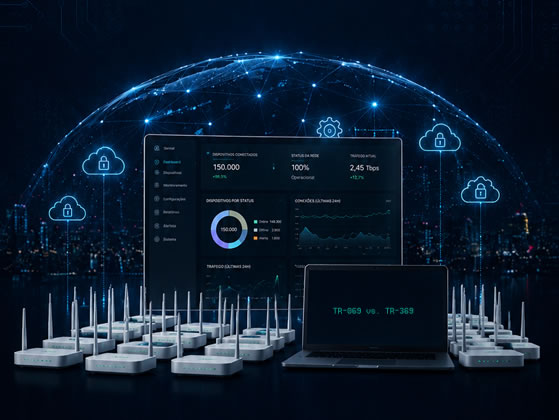
Remote management enables service providers and hardware manufacturers to configure equipment, execute firmware upgrades, run diagnostics, and track performance indicators without requiring on-site intervention.
For over two decades, TR-069 established itself as the primary protocol for this purpose. TR-369, also known as the User Services Platform (USP), emerged as an evolution of this model, leveraging a message-driven architecture and supporting diverse Message Transfer Protocols (MTPs).
To evaluate how these technologies behave at scale, we conducted a comparative benchmark using 150,000 simulated CPEs, monitoring both initial device onboarding and periodic telemetry collection.
How the Test Was Conducted
Two distinct laboratory environments were built using open-source solutions:
- TR-069 Environment: GenieACS as the ACS;
- TR-369 Environment: Oktopus as the USP Controller, with MQTT as the transport protocol;
- Database: Both GenieACS and Oktopus utilized MongoDB;
- CPEs: Proprietary in-house developed simulators;
- Infrastructure: Intel Core i5-10400 processor and 32 GB RAM;
- Duration: 1 hour per experiment run.
Following the onboarding of all 150,000 CPEs, a telemetry collector queried the transmitted and received byte counters (TX/RX) on the simulated devices' Ethernet interfaces every minute.
The minimum pacing interval that allowed stable onboarding completion was 10 milliseconds between CPE requests in TR-069, compared to 1 millisecond in TR-369. Both environments successfully completed the process, despite experiencing transient errors and retries. In the TR-069 scenario, the Periodic Inform interval was set to 5 minutes.
Key Results
Performance comparison of remote device management technologies using 150,000 simulated CPEs.
| Metric / Indicator | TR-069 | TR-369 | TR-369 Efficiency Gain |
|---|---|---|---|
| Initialized / Onboarded CPEs | 150,000 | 150,000 | — |
| Onboarding Time | 30m 54s | 3m 20s | +89% |
| Avg. CPU Usage (Telemetry) | 5.74 cores | 0.40 cores | +93% |
| Avg. Network Traffic (Telemetry) | 179.03 Mbps | 21.11 Mbps | +88% |
| Avg. Disk Write Rate | 2.45 MiB/s | 0.014 MiB/s | +99% |
| Peak Memory Usage | 6.9 GiB | 16.8 GiB | -143% |
CPE Onboarding & Initialization
TR-369 completed the onboarding process in approximately 3 minutes and 20 seconds, whereas TR-069 required over half an hour.
Under the evaluated conditions, the combination of USP, Oktopus, and MQTT sustained a significantly higher device ingress rate. At a 1 ms pacing interval, the TR-069 lab failed to onboard the 150,000 CPEs within the test duration due to a high volume of failed CWMP sessions.
Performance During Telemetry Collection
Once all CPEs were registered, the TR-069 backend consumed, on average, more than 14 times the CPU capacity of the TR-369 environment. Average network traffic was 88% lower in TR-369, while disk write activity dropped by 99%.
In the TR-069 setup, operations occurred via standard CWMP sessions utilizing SOAP over HTTP messaging. In contrast, the TR-369 lab transmitted USP messages over MQTT via persistent connections maintained between the CPEs, the message broker, and the controller.
Furthermore, the USP controller queried parameters directly from the end devices without caching a full state copy of all collected data on the backend, unlike the behavior observed with GenieACS.
These architectural differences help explain the drastically reduced overhead in TR-369, though they are not the sole contributing factors. Database indexing, persistence strategies, polling frequency, backend implementation details, and simulator configurations also influence final performance metrics.
Higher Memory Footprint
The primary trade-off observed in TR-369 was memory consumption. During the telemetry phase, the TR-069 environment peaked at approximately 6.9 GiB, whereas TR-369 reached roughly 16.8 GiB.
This increase is likely tied to persistent MQTT TCP connections, message broker overhead, device state tracking, and internal implementation specifics of the stack. Because individual component consumption was not isolated, the full memory delta cannot be attributed solely to the USP protocol itself.
Ultimately, the results reveal a clear resource trade-off: the TR-369 environment drastically reduced CPU load, network throughput, and disk I/O, but demanded higher RAM allocation.
Key Insights
In the analyzed scenario, TR-369 demonstrated clear advantages for high-density operations requiring frequent telemetry polling. The substantial reduction in CPU usage, network traffic, and disk writes relieves pressure on infrastructure and facilitates horizontal scaling.
Conversely, TR-069 maintained a significantly lower memory footprint and remains a mature, battle-tested, and widely supported technology suitable for standard provisioning and diagnostic workflows.
These findings do not render one technology universally superior to the other. Rather, they show that while the evaluated TR-369 architecture was far more resource-efficient across most metrics, it also introduced new system sizing and capacity requirements.
When Scale Truly Matters
The ability to onboard devices rapidly is particularly critical during mass power outages, network core failures, or widespread connectivity restorations. During these "thundering herd" events, thousands of CPEs simultaneously attempt to reconnect, request provisioning, and transmit diagnostic data within a narrow window.
Although this experiment used controlled pacing intervals, the results underscore the importance of understanding an environment's device ingress limits. For network architects, ACS administrators, and USP Controller operators, the central question is whether the infrastructure can absorb a massive reconnection spike without compromising network management capabilities.
Beyond choosing between TR-069 and TR-369, operators must understand implementation limits, conduct stress testing, and properly size infrastructure for peak demand scenarios.
Conclusion
Under the benchmarked conditions, TR-369 delivered significantly faster device onboarding along with reduced CPU usage, lower network traffic, and minimal disk write I/O—at the cost of higher memory utilization.
Protocol selection should consider the existing installed base, total device volume, telemetry polling frequency, and available hardware resources. In many deployment roadmaps, maintaining concurrent support for both TR-069 and TR-369 is necessary during a phased migration.
Venko Networks specializes in implementing and deploying TR-069 and TR-369 protocols on embedded devices using proprietary SDKs or OpenWrt-based platforms. Our engineering services encompass ACS and USP Controller integration, data model adaptation, stress testing, interoperability validation, and performance optimization.
Contact one of our engineering specialists [here], to obtain technical guidance tailored to your project requirements..Source: Venko Networks
Image: Canva, ChatGPT, Magnific/Composition
