

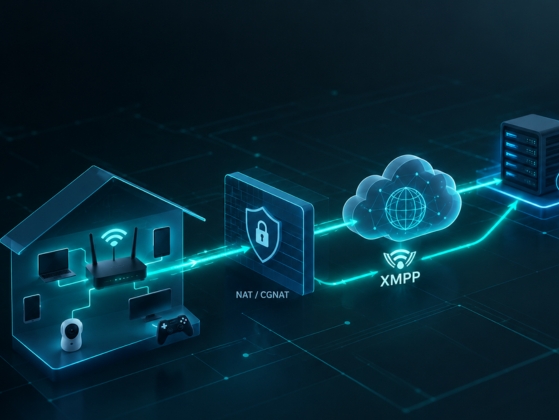
For over two decades, TR-069 has established itself as one of the primary technologies for the remote management of broadband equipment.
Through it, providers and manufacturers can configure routers and ONTs, update firmware, perform diagnostics, and query device information without on-site intervention.
Normally, communication is initiated by the CPE itself, the term used to represent the managed equipment. It opens a session with the ACS, the server responsible for management, and receives the operations to be executed.
But what happens when the ACS needs to initiate an operation immediately?
How Connection Request works
In TR-069, the ACS does not maintain a permanent connection with each CPE. When it needs to perform an operation, it sends a Connection Request to the equipment. This request does not contain configuration commands. It serves only as a trigger for the CPE to initiate a new session with the ACS.
Within this session, the ACS can query parameters, change settings, perform diagnostics, or initiate a firmware update.
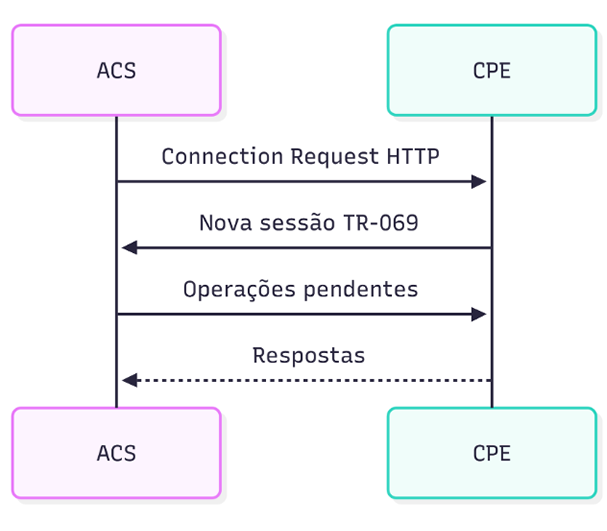
When the ACS can directly reach the CPE, this process works normally. The problem arises when the equipment is behind NAT, CGNAT, or firewalls.
Why NAT and CGNAT are a problem
In residential networks, NAT allows multiple devices to share a single public IP address. CGNAT applies the same principle in the provider's infrastructure, sharing public addresses among several subscribers.
These mechanisms allow the CPE to initiate connections to external servers, but normally prevent an external server from opening connections directly to it.
Since the traditional Connection Request is an inbound request initiated by the ACS, it is usually blocked by the firewall or directed to a private address inaccessible from the external network.
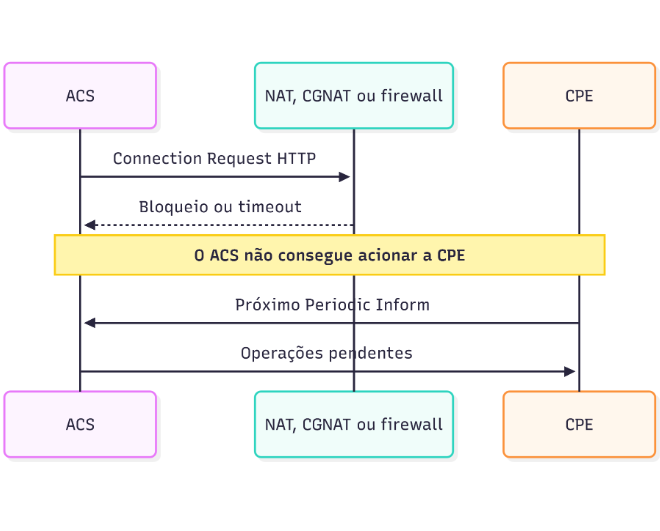
TR-069 continues to function because the CPE can still initiate outbound connections. However, without a functional Connection Request, the ACS must wait for the next spontaneous connection from the equipment.
When an operation can take hours
CPEs typically initiate periodic sessions with the ACS through the Periodic Inform. This interval can be configured in minutes or hours: longer intervals reduce the number of requests and server resource consumption, but also increase the waiting time when the ACS needs to directly trigger the equipment.
Consider a CPE configured to send a Periodic Inform every six hours. If the ACS needs to change a setting right after a session ends, the operation will remain pending for nearly six hours.
This delay occurs not because TR-069 commands themselves are slow, but because the ACS lacks a channel to immediately notify the CPE of a pending task.
How XMPP solves this problem
With XMPP, the CPE itself establishes an outbound connection to a messaging server and maintains this channel open. Because it originates from the device, this connection bypasses restrictions like NAT, CGNAT, or firewalls that block externally initiated connections. Whenever it needs to perform an operation, the ACS sends a command via the XMPP server. The CPE receives this signal and promptly initiates a new TR-069 session with the ACS.
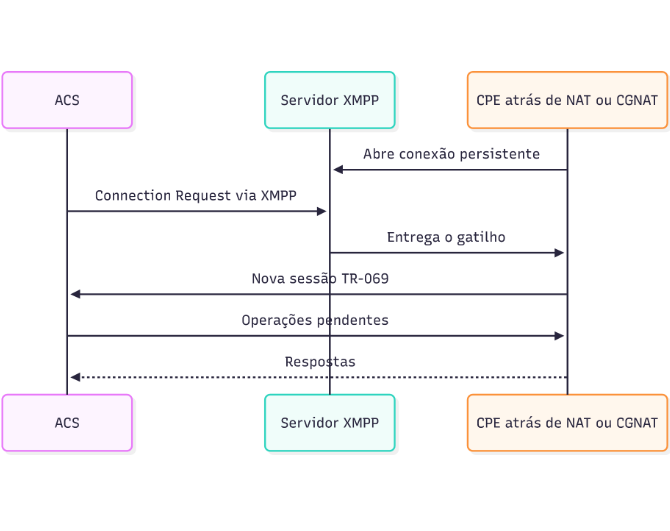
In simple terms, the HTTP Connection Request tries to open a new path to the CPE, while XMPP leverages a connection the equipment has already opened. XMPP does not replace TR-069 nor transport management commands; it only requests that the CPE start a session. Configurations, diagnostics, and updates continue to be executed via TR-069.
As a result, an operation that might have waited several hours for the next Periodic Inform can now be initiated in a few seconds.
Operational benefits
The primary benefit of XMPP is not making each individual command faster, but eliminating the wait to open a management session.
This streamlines critical routines, such as:
- Applying emergency fixes;
- Parameter adjustments;
- Execution of tests and diagnostics;
- Equipment reboots;
Initiating firmware updates.
For support and operations teams, this translates into faster response times and a greater ability to act on devices in networks with NAT, CGNAT, or restrictive firewall policies.
And how does it work in TR-369?
TR-369, also known as USP, was designed with a different architecture. Transport protocols like MQTT, STOMP, and WebSockets maintain continuous bidirectional channels between the Agent installed on the equipment and the management Controller. Thus, the Controller sends commands directly through the established channel, without relying on a separate HTTP Connection Request.
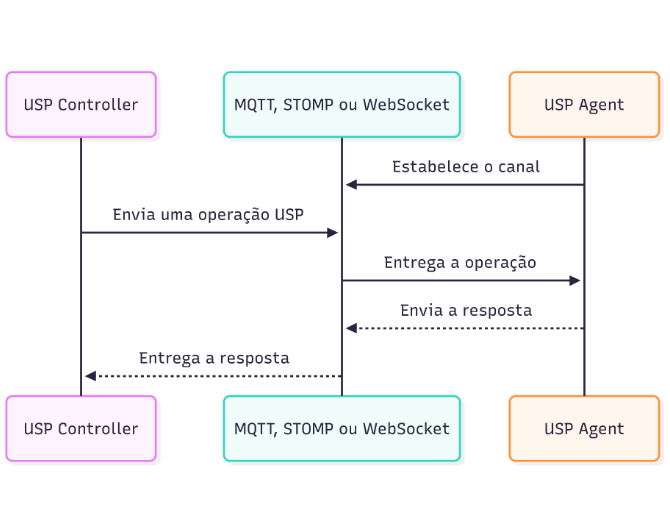
This does not mean connections never fail or that equipment is always available. The difference is that bidirectional communication is part of TR-369's native architecture, whereas in TR-069, XMPP acts as a complementary mechanism.
An evolution for existing networks
XMPP addresses a specific challenge in TR-069: allowing the ACS to quickly trigger equipment that cannot directly receive an HTTP Connection Request. By maintaining a persistent outbound connection, the CPE remains accessible even behind NAT, CGNAT, or firewalls.
In this way, providers can continue to leverage the maturity and wide compatibility of TR-069 while reducing dependence on the Periodic Inform to initiate operations. Rather than just making management "real-time," XMPP provides the ACS with a reliable path to request that the CPE connect whenever a new operation needs to be executed.
Venko's Role
Venko Networks works on TR-069 implementation, including XMPP support in embedded devices, through its own SDK or OpenWrt-based platforms. The work includes ACS integration, data model adaptation, load testing, interoperability validation, and performance optimization.
Speak with one of our specialists by clicking here, and receive all the necessary guidance for your project.
Source: Venko Networks
Image: Canva, ChatGPT, Magnific/Composition
