

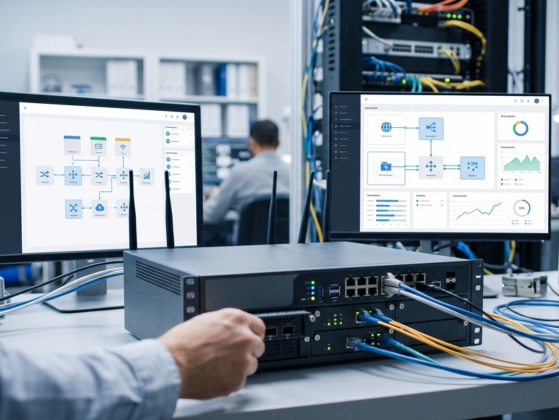
Testing device management platforms (such as ACS and Controllers) at production scale requires replicating the complexity of real-world networks with hundreds of thousands of connected CPEs. Building and maintaining physical testbeds of this magnitude consumes substantial floor space, power, and continuous operational overhead, rendering massive tests expensive, slow, and difficult to reproduce.
CPE simulation resolves this bottleneck. Instead of deploying thousands of physical routers and gateways, virtual device populations communicate with management platforms using native protocols such as TR-069 and TR-369. This approach enables capacity, interoperability, and resilience validation within a controlled and repeatable environment.
Virtual Populations with Autonomous Behavior
An effective simulator goes beyond raw traffic generation. Each virtual device operates with an independent lifecycle, maintaining a unique identifier (serial number or endpoint), a specific data model, granular access permissions, and its own operational state.
The simulators developed by Venko were engineered to address these operational requirements:
- TR-069 Simulator: Replicates the complete management lifecycle with the ACS. It supports both TR-098 (InternetGatewayDevice) and TR-181 (Device) data models, executing operations such as parameter discovery, read/write commands, object instantiation/deletion, reboots, factory resets, and firmware upgrades with scheduled maintenance windows.
- TR-369 Simulator: Models USP (User Services Platform) Agents connected to a Controller via an MQTT broker, each utilizing a dedicated topic and persistent connection. Upon initialization, it emits the Boot! event and dispatches periodic notifications, allowing the Controller to query and mutate authorized instances and parameters. Its architecture is optimized to benchmark broker and Controller capacity under massive concurrency.
Interoperability and Model Heterogeneity
Production networks encompass heterogeneous fleets from diverse vendors, hardware revisions, and firmware versions. The simulators allow operators to configure heterogeneous CPE profiles with varying parameters, data types, and permission levels.
This flexibility validates platform fault tolerance against schema discrepancies—such as missing parameters or divergent data structures—and verifies whether requested RPC operations are actually interpreted and applied by the simulated CPE, rather than merely dispatched by the ACS or Controller.
Lifecycle, Telemetry, and Fault Injection
The simulators cover every operational phase of the device fleet:
- Connection Events: Spans initial bootstrapping and periodic Informs/notifications to ACS-initiated connection requests (TR-069) and persistent MQTT sessions (TR-369). Scenarios can simulate gradual ramp-ups or sudden connection storms, accurately modeling fleet reconnection dynamics following power outages.
- Dynamic Telemetry: Generates realistic, varying values for metrics like CPU usage, memory consumption, operating temperature, and network throughput, which are critical for validating alerting rules and ingestion pipelines in time-series databases.
- Network Degradation: Injects synthetic latency, response timeouts, and forced disconnections to evaluate system resilience when handling degraded or erratic network paths.
Early Bottleneck Identification
Stress testing exposes architectural limits that typically remain hidden during functional validation. Massive workloads and concurrent operations expose unbounded queue growth, TCP socket exhaustion, timeout spikes, excessive retries, and database lock contention.
During execution, the test harness provides granular telemetry: connection rates, session durations, per-RPC latency, notification throughput, infrastructure resource utilization (CPU/memory), and post-failure recovery times.
Scalability, Repeatability, and Complementary Validation
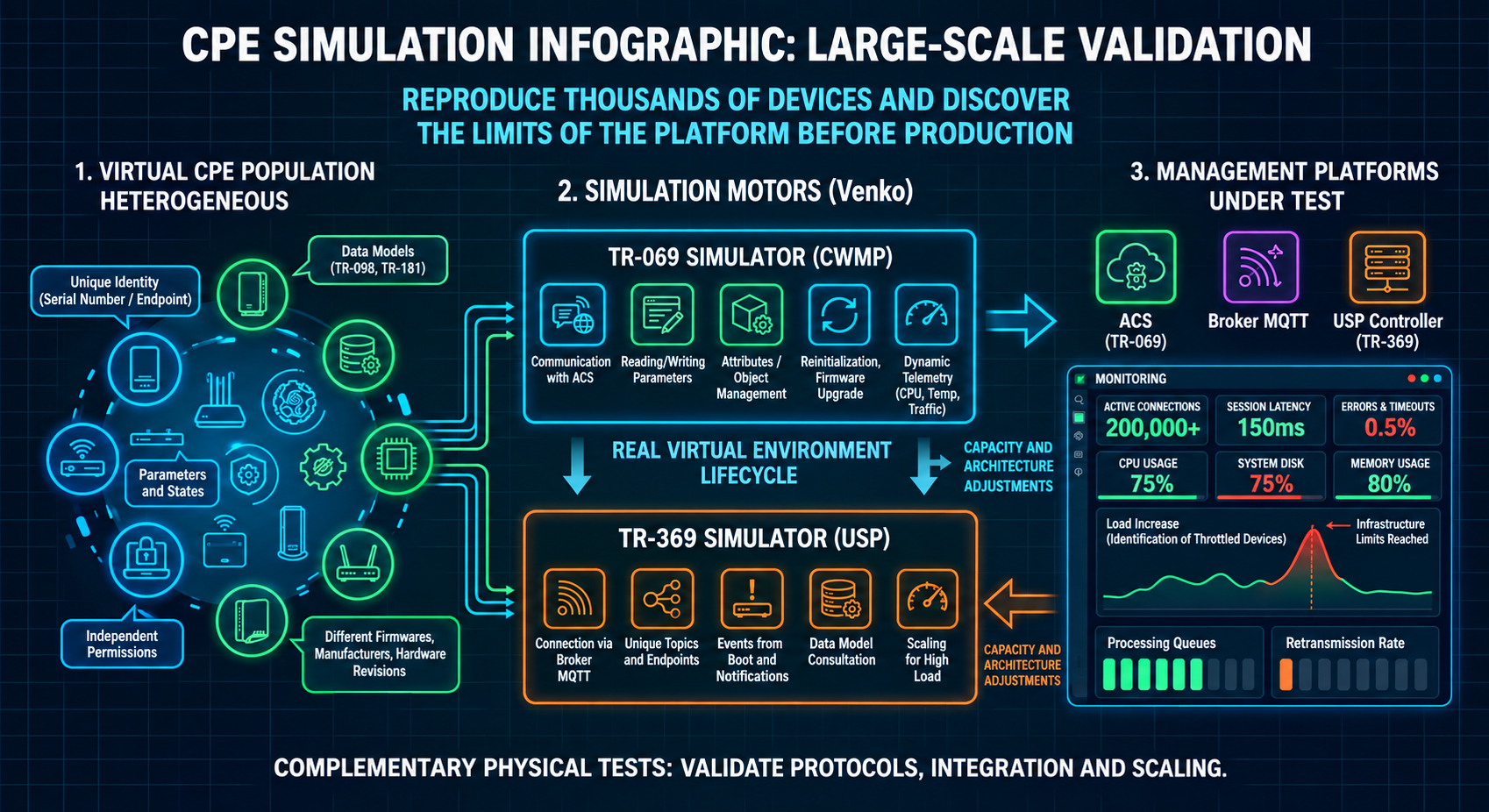
The platform scales seamlessly from functional qualification using dozens of instances to massive load testing. The TR-369 simulator, in particular, is engineered to handle scenarios exceeding hundreds of thousands of concurrent CPEs.
In an internal benchmark, Venko simulated 150,000 concurrent CPEs to compare GenieACS (TR-069) against Oktopus (TR-369 USP Controller), measuring registration velocity, infrastructure footprint, and periodic telemetry processing under identical workloads.
Full details and results of this benchmark are documented in our article comparing TR-069 and TR-369 performance .
Simulation does not replace physical bench testing, which remains vital for validating radio frequency (RF), physical chipsets, and low-level driver behaviors. However, it plays a complementary and decisive role: validating protocols, logical integrations, and architectural scaling boundaries before production rollout—identifying defects early, reducing capital expenditure, and mitigating operational risk.
Talk to a Venko specialist clicking here.
Source: Venko
Image: Canva / Venko
